The claim is required
Each action has a public displayed rank chosen by the game. Your opponent always knows the claim, never the hidden card.
 Goblin BluffRoyal Field ManualLearn in 60 seconds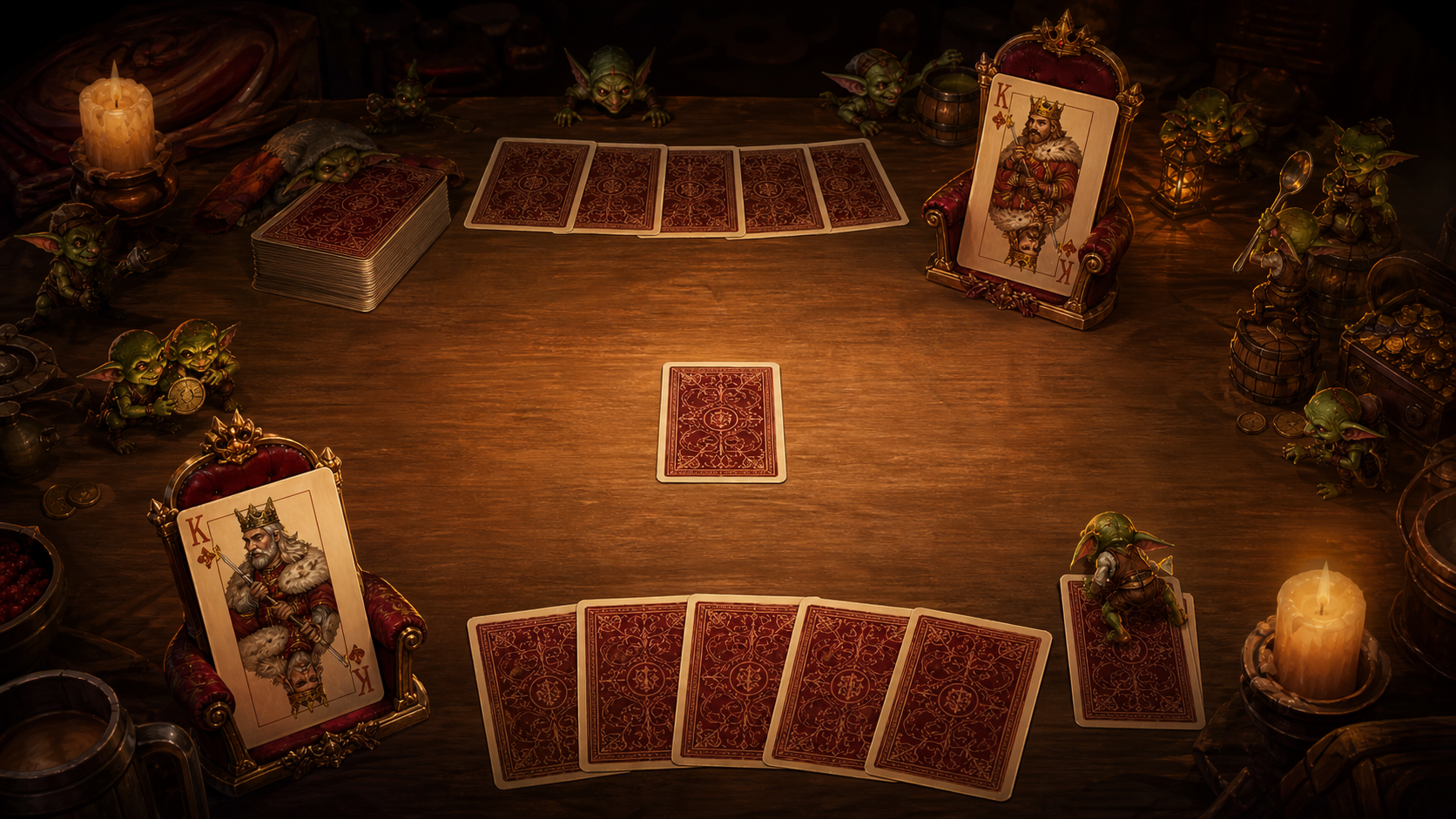
The official player handbook
A complete guide to claims, challenges, cards, opponents, match settings, royal entrances, side matches—and the tiny civilization making terrible decisions around your table.
The shortest possible explanation
The game chooses what your card must appear to be. You choose whether the claim is true.
At the start of your turn, draw one card. Keep your real hand secret.
Drag any card from your hand to the table. It is displayed as the required claim.
The opponent chooses to Believe or Call Bullshit without seeing the real card.
A correct call hurts the liar. A wrong call hurts the challenger. Reach zero HP and lose.
Legal bluff example
The opponent sees “King,” not the Four. Playing the wrong rank is allowed—it is the point of the game.
Core rules
Everything that can change who wins is contained in this loop. Presentation never changes the ruling.
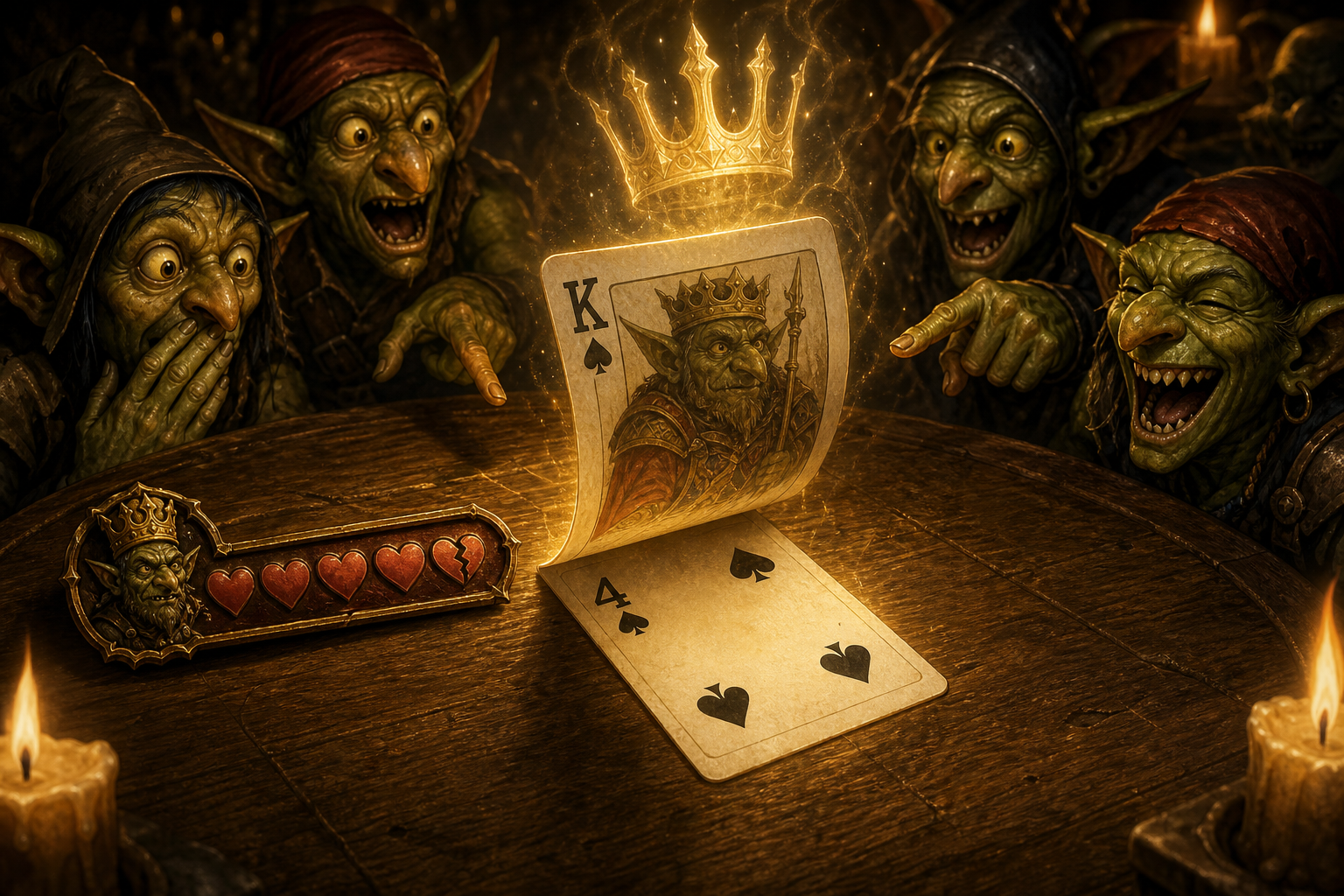
Illustration: a King claim challenged and revealed as a Four.
Each action has a public displayed rank chosen by the game. Your opponent always knows the claim, never the hidden card.
Matching the claim tells the truth. Playing another rank creates a lie. Suit currently has no rule effect.
The card enters the discard without a reveal. Belief does not confirm honesty and cannot be corrected later.
If real rank differs from the claim, the liar loses damage. If it matches, the challenger loses damage.
Classic Kings have 5 HP. A standard accusation deals 1 damage. The first King reduced to zero loses.
Full turn flow
The two sides follow the same legal card rules. Only the response interface differs.
Your turn
Enemy turn
Bluffing school
There is no perfect call. Strong play combines card evidence, opponent tendencies, and the cost of being wrong.
If you hold several copies of the claimed rank, fewer remain available to the opponent. That makes their claim less comfortable.
At high HP, a risky information-gathering call can be affordable. At 1 HP, a marginal call can end the match.
Only revealed cards are certain. Believed cards remain unknown, so never count an accepted claim as proven truth.
Repeated truth-then-bluff patterns become readable—especially to Memory Mike and the Royal Judge.
An honest face-card claim may seem too convenient. Against frequent callers, truth is sometimes the strongest trap.
You do not need to challenge every doubtful card. Preserve HP when the evidence is weak or the opponent benefits from baiting calls.
The royal opposition
Every AI follows the same rules and information boundary. Personality changes judgment, risk, memory, and bluffing—not cards, damage, draws, or HP.
The gentle read
Trusting, predictable, and reluctant to accuse. Bluff sparingly against him; he gives honest claims more room.
The frequent caller
Sees lies everywhere. Feed him a few honest claims and let his suspicion cost him HP.
The card counter
Tracks public reveals and grows dangerous late. Change patterns before he builds a clean read.
The risk taker
Bluffs boldly and reacts to streaks. Expect volatility instead of a stable threshold.
The chaos pick
Wild, noisy, and strategically questionable. Probabilities help, but certainty is a trap.
The precise one
Calm and probability-led. Weak tells rarely move the Judge; card evidence does.
The AI may know
Its own hand · displayed claims · revealed cards · public HP · discard count · deck size · completed side matches.
The AI never knows
Your hidden hand · your unrevealed played card · secret deck order · future random outcomes.
Build your match
Casual Mode lets you choose the opponent, arena, base rules, and compatible optional modifiers.
A second cosmetic goblin burst follows every public claim.
Shorter AI thinking and faster presentation.
Kings begin with twice the selected ruleset HP.
Kings begin with half the selected ruleset HP.
Bullshit outcomes deal twice the selected ruleset damage.
Patterns are recorded, but no side match interrupts play.
No side matches and much more cosmetic comedy.
A neutral modifier with no additional adjustments.
Fast turns, double damage, double goblins, and frequent comedy.
Castle, Forest, Dungeon, Pirate Ship, and Volcano are selectable placeholders that currently use the Tavern table presentation.
Beyond the core duel
These systems add presentation or bounded interruptions. The bluff result remains authoritative.
Special card
One Reset Card is appended to a match. When played, it consumes itself, combines the undrawn deck and discard, clears revealed-card and pattern history, resets card ownership and claims, then shuffles the rebuilt deck.
The fire, drunk goblin, flask, panic, and bucket business is presentation after the reset has already completed.Pattern
A Matching Square occurs when each player’s latest two real cards share one rank across all four cards. The game detects the authoritative ranks after normal resolution and consumes that pattern history.
This can trigger the currently implemented side match unless No Side Matches is active.Side match
Six chambers, one hidden loaded chamber, alternating identical trigger pulls. Neither side knows the loaded position. The losing King takes the side match’s damage, then the paused card turn resumes exactly where it stopped.
Poker, Coin Flip, Dice Roll, Reaction Test, Arm Wrestling, Chess, Memory, and Rock Paper Scissors are future placeholders—not active modes.Face-card presentation
Royal actors are brief, pooled presentation characters. They never replace the played card or delay the authoritative result.
Acrobatic entrance · 11 goblins
Graceful entrance · 12 goblins
Sword salute · 13 goblins
Golden entrance · 14 goblins
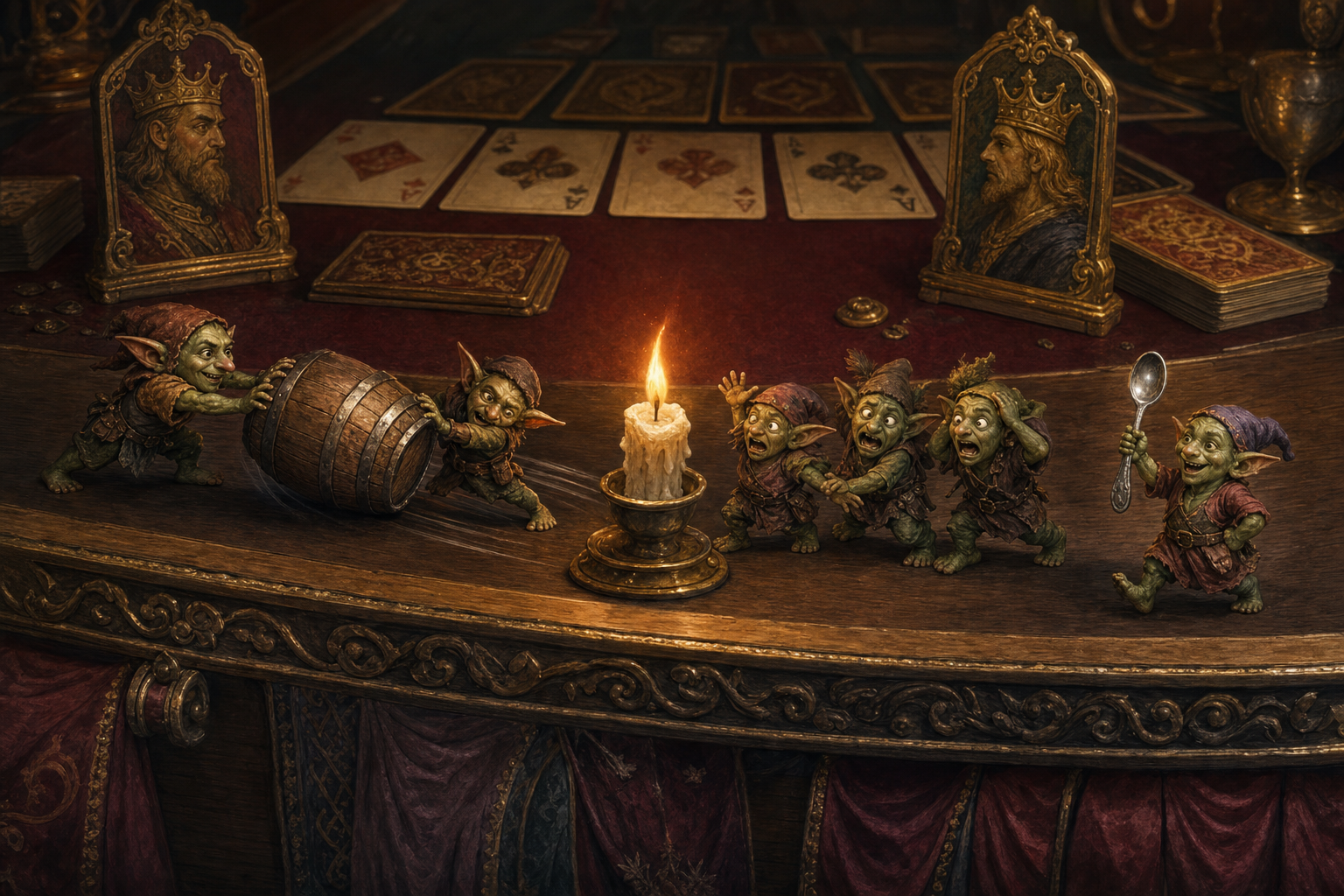
The Goblin Engine
Goblins inspect, carry, follow, drop, watch, celebrate, panic, misunderstand, and recover. Their little stories can combine, but they always yield visual priority to cards, Kings, and UI.
Public claim → crowd size
Only the displayed claim crosses into the Goblin Engine. A hidden Four shown as King produces thirteen goblins.
Controls
Player settings
Questions from the table
The answers below describe the current playable build, not future campaign or multiplayer plans.
Yes. That is the central bluff. Any legal card from your hand may be placed; the opponent sees only the required claim until a challenge reveals it.
Not in the current core rules. Suits identify physical cards, while rank determines whether a claim is truthful.
No. A believed card stays hidden and enters the discard pile without revealing its real rank.
No. Opponents know their own hand, public claims, revealed cards, HP, deck and discard counts, and public match history only.
Never. Goblins cannot deal damage, alter cards, change turns, influence AI, or affect randomness. They are a cosmetic civilization.
The existing discard is reshuffled as needed. Hidden cards remain hidden information unless another system legitimately revealed them.
No. Tavern is the current authored arena. Several arena and side-match names are extension placeholders and are clearly marked as future content.